
Best Practices for BSL Lab Autoclaves
By: Priorclave
Categories: Health & Safety Lab Autoclaves Lab Practices

A biosafety lab is any lab designed to safely handle potentially dangerous pathogens, microbes, and their toxins. In the U.S., their design is dictated by the CDC specifications outlined in Biosafety in Microbiological and Biomedical Laboratories (BMBL). These best practices are largely echoed elsewhere in the world, such as in EU Directive 2000/54/EC, which has made them a de facto global standard for biological risk management and containment practices.
All BSL labs must follow defined decontamination and sterilization protocols. While only the highest-risk labs are required to have autoclaves, most labs install one as a practical matter.
What are the Four Types of BSL Labs?
BMBL breaks facilities into four categories, establishing these four biosafety levels (BSL):
- BSL-1: Minimal risk. These labs only handle fully identified and well understood strains of viable biological agents that are not known to cause disease in healthy adult humans. Examples of required protective measures include standard lab coats, gloves, and goggles.
- BSL-2: Risk of exposure through direct physical contact. These are labs that handle moderate-risk agents that are known to cause human disease through ingestion, contact with the mucous membranes, or exposure through broken skin (i.e., inadvertent needle sticks or fluid splashing in the eyes or mouth). Required protective measures include biosafety cabinets (BSC), gloves, face shields, and so on.
- BSL-3: Risk of exposure through airborne transmission. These labs handle agents with a known potential for aerosol transmission, agents that cause serious or lethal infections, or agents which are poorly understood and potentially serious or lethal. Required protective measures include “air lock”-style doors, air filtration, respirator masks and face protection.
- BSL-4: Extremely high or entirely unknown risk. These labs handle exotic agents that pose a high risk of life-threatening disease by infectious aerosols and for which no treatment is available, as well as poorly understood agents with an unknown risk of transmission. Required protective measures include dedicated air supplies, positive-pressure suits, interlocking double-doors connecting the lab to the facility, monitoring, in-lab decontamination and sterilization methods, and so on.
Biosafety levels may also be referred to as “Pathogen Levels,” “Protection Levels,” or “Containment Levels,” but they are all fundamentally equivalent: A BSL-3 lab is the same as a P3 lab, which is the same as a CL1 lab.
How Common are BSL-3 and BSL-4 Labs?
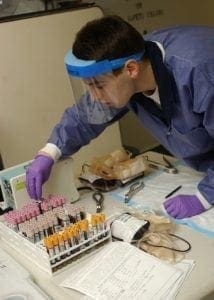
BSL-3 and BSL-4 containment practices (shown in the images below) are what most people imagine when they think of a BSL lab. Of the two, BSL-3 is by far the most common.
A recent study counted 3,515 BSL-3 laboratories globally, with most (approximately 1,600) in the U.S. The UK leads in the number of BSL-3 labs relative to population size. These numbers reflect a significant growth in BSL-3 and BSL-4 lab construction over the last 20 years, largely driven by concerns about potential biological attacks and pandemics following the anthrax attacks in the U.S. during the weeks after 9/11, and during the 2003 SARS pandemic.
Why Do Most BSL-3 Facilities Install an In-Lab Autoclave?
The BMBL notes that a validated decontamination method is required for a BSL-3 lab, and suggests it is best for this to be in the lab itself. While an autoclave is advised, especially for ABSL labs (BSL labs that work with animals), it is not specifically mandated for BSL-3. By contrast, a pass-thru autoclave is explicitly required for higher-risk BSL-4 labs.
So, then, why does almost every BSL-3 lab choose to take on the expense of installing an autoclave, usually as a pass-thru sterilizer mounted directly into the wall separating the containment area from the rest of the facility?
There are three reasons BSL-3 labs consistently choose in-lab research-grade steam autoclaves, even though they have cheaper options:
- Eliminating Transport Risk: While a BSL-3 lab can rely on a shared autoclave elsewhere in their facility for waste decontamination, that means transporting potentially lethal, aerosol-transmissible pathogens outside the containment zone and through shared corridors to a shared sterilization department. An accident in transport, error in packaging the waste prior to transport, or mistake in the sterilization department could prove disastrous.
- Outside Requirement: While BMBL and EU Directive 2000/54/EC are authoritative guides, they are far from the only requirements for a BSL-3 lab. BMBL does not mandate an in-lab autoclave, but the NIH Design Requirements Manual (DRM) and major academic institutions generally do require an autoclave within the containment barrier. Likewise, most Institutional Biosafety Committees (IBC) and Biosafety Officers (BSO) for the institutions that house these labs prefer that their BSL labs have their own autoclave.
- Convenience: While sterilizing waste outside of the containment area is an option in a BSL-3 lab, it can trigger complex chain-of-custody, inventory tracking, and physical security requirements. When you factor in the staff hours to comply with these standards, an in-lab autoclave is often the more cost effective (let alone safer) option.
Trust Priorclave to Safely Handle Your Biocontainment Needs
Biocontainment has always been front of mind for Priorclave. The last recorded smallpox death in the world was in 1978—not in some tiny village far from the benefits of modern medicine, but in a medical research lab in Birmingham, England. Although the precise path the pathogen took remains distressingly murky, this final smallpox death without a doubt would have been prevented by better containment and more well-defined lab practices.
This incident was a violent wake-up call in the research world, and left an impression on Priorclave’s founders: Seemingly minor cut corners, combined with a little bad luck, can have disastrous results. This has underscored every design decision, not just in our noted pass-thru autoclaves (popular with BSL-3 labs worldwide), but in every autoclave we build and sell, regardless of its final destination or intended task.
If you are ready to discuss autoclave safety improvements in your lab, have questions about next steps, or simply want answers to your questions, please feel free to reach out to us. Our team of experts is happy to assist you anytime.